Labels are more than a simple way to advertise a brand name to customers for local product businesses. A good label can make your product look professional, convey necessary information and create a positive impression on your customers.
From selling food and beverages to cosmetics, handmade and retail products, getting your labels right is essential to your packaging. But there are common mistakes that businesses can make when creating art or determining their printing requirements.
Here are some of the common printing label mistakes to watch out for when planning label printing in Singapore.
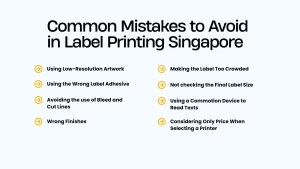
1. Using Low-Resolution Artwork
The most frequent mistake made when printing labels is the quality of artwork sent.
What works great on the computer or phone screen may not work well when it’s printed. Low resolution images may end up being fuzzy, pixelated, or not very detailed when printed on a physical label.
This is especially true if your label contains a company logo, product images, small text or detailed graphics.
Ideally, businesses should send print ready artwork in an appropriate resolution and file format for the creation of professional looking labels. Logos and other artwork that can still be sharp at various sizes may be helpful in using a vector format like AI, EPS or PDF.
To ensure your artwork is successful when it is sent for printing, please verify the following:
- Images are at a high resolution and print-able.
- Logos and graphics have no pixelation.
- Readable text size at the actual label size.
- Critical design features are not too close to edges.
- Colours and artwork are made as per the requirements of the printer.
If you have any doubt about your artwork, have it printed on your label by your label printer to see if it is suitable for production.
2. Using the Wrong Label Adhesive
Not all label materials can be used for all types of products.
This is a critical factor for the local product businesses for which the labels can be subjected to moisture, oil, heat, refrigeration, handling and outside conditions depending on the product.
Paper, for instance, is good for some dry products, but not for those that are often touched by water or humidity.
A key factor Singapore businesses need to consider is where and how the label will be used when selecting a material for the printing.
Ask yourself:
- Will the product be stored in a refrigerator?
- Will the product come in contact with water?
- Will the label come into contact with oil or grease?
- Will the product be exposed to the elements?
- Is a high-end or luxury packaging needed?
- For how long should the label be kept in good condition?
Use can be paper or synthetic, depending on the application.
The lower the price, the not necessarily the lowest cost. When the label peels off, fades or is damaged early after the product is introduced to the customer, it can impact the customer’s impression of your brand.
3. Avoiding the use of Bleed and Cut Lines
Another frequent error is creating artwork without taking into mind the end cutting process.
If labels are printed and cut, there will be very small variations in the cutting position. When your artwork cuts at the exact end of the label, you might find that you have white edges which you don’t want.
This is when bleed is useful.
Bleed is an additional area of artwork that extends beyond the final cut line. It provides some space for cutting the printer and will help to make sure the background or design is up to the edge of the printed label.
If you are making a label that uses a full-colour background, the background should not just reach the cut lines of the label, it should go beyond the cutting area.
Meanwhile, key details like company logos, company names and text must be preserved in a safe zone that is away from the edges.
Check with your print shop the required bleed and safe-area requirements before submitting artwork. Requirements differ between different printers, label size and production methods.
4. Wrong Finishes
The label end can make all the difference in the world to how it looks and feels on your product.
There are businesses that are particularly concerned with the design but forget about the final finish. However, the difference between a matte or glossy finish will affect customers’ perceptions of the product.
Labels with gloss finish will appear brighter and more colorful. It can be great for designs with lots of colour or if you’re looking to create a design that stands out.
Matte finish, however, may offer a more subtle and elegant look. It might work well in a minimalist branding, skincare products, candles, specialty food or other products looking for a chic aesthetic.
Finish is the final aspect of packaging that should be consistent with your use.
For instance, if the product is going to be handled often, it may require a coating to provide extra protection from scratching or water, depending on the material and printing technique.
Do not select a finish just because it is pleasing to the eye on screen, because the finished product may be required to be stored, transported, displayed and handled differently.
5. Making the Label Too Crowded
When designing a product label, it is easy to add as much information as possible. But, the more you try to put into it the more complicated the design will get.
The best product label will be clear and present without confusing the customer.
Think about what information is necessary, e.g.
- Product name
- Brand name or logo
- Key product information
- Ingredients or product information (if applicable).
- Net weight or volume
- Instructions for use (as appropriate)
- An email address or phone number.
- Any required or barcode information in the text, please include it.
Order information so that the most important information is presented first. Labels are often much easier to read and understand with clear typography, the right spacing and a logical layout.
Keep in mind that the label, while your working on it on a computer, might appear large. However, small text can be extremely hard to read once it’s on a small bottle or jar, pouch, or even a box.
6. Not checking the Final Label Size
A second error is creating the art design prior to determining the actual label size.
A design which will print nicely on a large rectangular label may not be as effective if it has to be printed on a small bottle or a curved container.
When planning your artwork, be sure to measure the area for the label and double check with your printer. The form of packaging is also a factor to take into account, as well as the possibility that the label has to fold around the product.
For companies that manufacture several sizes of products, it is helpful to develop an identical labelling system. This enables various products to be branded in the same name, but still have different dimensions.
7. Using a Commotion Device to Read Texts
For thousands of labels already printed, a small error can be a costly issue.
Be sure to review the art, and provide a proof if applicable, before finalizing your order.
Check for spelling errors, product misinformation, missing details, colour variances and misalignments.
Also, when looking to the label, examine it at its natural scale, not just zoomed in on a design file.
Getting a second set of eyes on the artwork can also be beneficial. Someone with a fresh perspective could see that something is wrong that the original designer did not.
8. Considering Only Price When Selecting a Printer
Cost is, of course, one of the crucial factors for small businesses and startups. But sometimes, selecting a label printing service based on the cheapest bid and quote may lead to quality compromises, material selection, finishing, or consistency.
Rather, take into account the value it provides overall.
Take into account the following:
- Available label materials
- Printing quality
- Finishing options
- Minimum order quantities
- Production turnaround
- Customisation options
- Artwork requirements
- Repeat order ability
Consistency is especially vital for businesses that are local to the area. When your products are regularly on display to your customers, the colour and material of your label, or finishing, may lead to batches looking inconsistently finished.
Utilise Your Product Labels To Your Brand’s Advantage
It is important to design good labels that also take into account the printing requirements. Whether it’s picking the material or creating high-resolution art, each choice has the potential to influence the final look of your products.
Before confirming artwork for label printing, make sure that you have reviewed your artwork, label dimensions, material, bleed and artwork finishing.
Most significantly, consider the product and the customers first. The highest priced label does not necessarily indicate the best label. It’s the one that’s professional, conveys the right information, fits the packaging, and is right for the product’s use.
Frequently Asked Questions
1.What is the best material for product labels?
There is no single best material for every product. The right option depends on factors such as the packaging surface, exposure to moisture, handling conditions, product type, and desired appearance. Ask your printer which material is most suitable for your application.
2. What resolution should my label artwork be?
Print artwork should be prepared according to your printer’s specifications. High-resolution images are important to prevent blurry or pixelated results, while vector artwork is often preferred for logos and graphics that need to remain sharp.
3. Why do I need bleed for label printing?
Bleed extends the artwork beyond the final cutting area. It helps prevent unwanted white edges caused by small variations during the cutting process.
4. Should I choose a matte or glossy label finish?
It depends on your branding and product requirements. Gloss can create a bright and vibrant appearance, while matte can provide a more subtle and premium look. Your printer can also recommend a suitable finish based on how the product will be handled.
5. Can I print custom-shaped product labels?
Yes, custom-shaped labels can be produced depending on the printing and cutting options available. If you have a specific shape in mind, discuss the design and production requirements with your printer before preparing the final artwork.
6. How can I avoid mistakes before printing my labels?
Check your artwork carefully for spelling, product information, dimensions, resolution, bleed, colours, and alignment. It is also recommended to have the final artwork reviewed and, where appropriate, request a proof before approving the full production run.

Anis Sofia is an SEO content writer specializing in crafting optimized articles, blogs, and website content. With expertise in keyword research, on-page SEO, and content strategy, Anis helps businesses build brand visibility and connect with their target audience through engaging, search-friendly writing.